
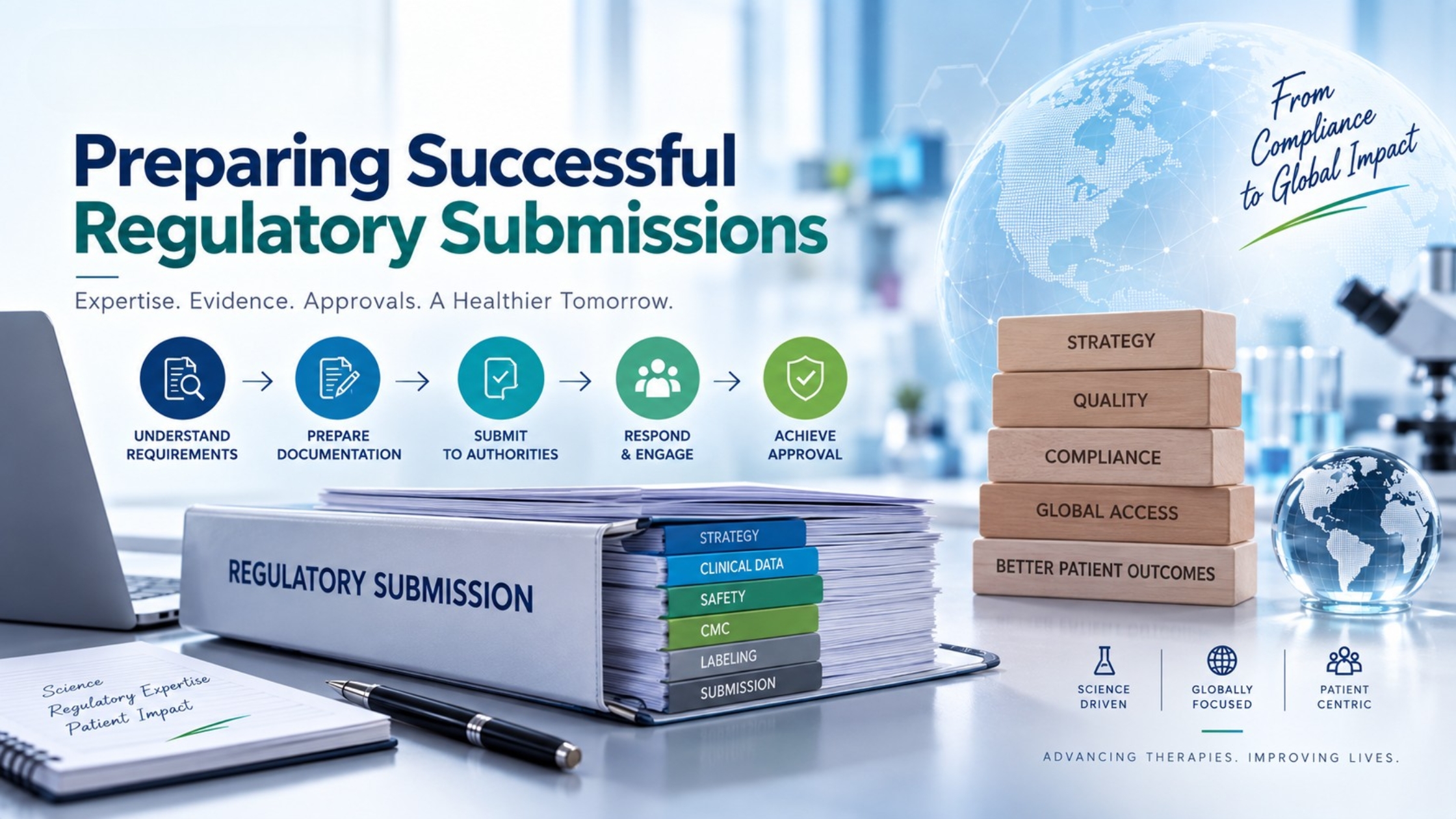
There is a difference between a regulatory submission that is filed and a regulatory submission that is approved. Both involve completing the same document list, meeting the same format requirements, and pressing the same send button on the FDA’s Electronic Submissions Gateway or the EMA’s CESP portal.
But the difference in outcomes – one receiving a swift approval, the other generating a list of 40 deficiency questions – comes down to a set of preparation decisions made in the months before the submission is filed.
Preparing a successful regulatory submission is a discipline. It requires scientific rigour, regulatory knowledge, meticulous attention to consistency, strategic communication, and the kind of quality management that leaves nothing to the reviewer’s imagination.
This guide gives you the practical expert framework for preparing regulatory submissions that maximise approval probability in 2026.
Quick Answer
Preparing a successful regulatory submission requires: starting regulatory writing early in the development process, aligning with regulatory authorities before filing through pre-submission meetings, building the CTD systematically with experienced regulatory medical writers, ensuring consistency across all documents through a rigorous quality management process, formatting the eCTD package to meet all technical requirements, and proactively addressing known regulatory concerns in the submission documents rather than waiting for questions. Well-prepared submissions reduce information requests, shorten review timelines, and build regulatory authority trust.
Why So Many Regulatory Submissions Fall Short
The frustrating reality is that a majority of submission failures are preventable. They are not caused by scientific inadequacy – they are caused by preparation failures that expert planning would have avoided.
The most common preparation failures include:
- Starting document preparation too late, leaving inadequate time for quality review cycles
- Writing documents in isolation rather than ensuring consistency across the full submission package
- Failing to engage with regulatory authorities before submission to align on known questions
- Using inexperienced or non-specialised writers for critical CTD modules – see our regulatory medical writing services
- Neglecting eCTD technical validation until submission is imminent
- Assuming that good data speaks for itself – it does not. Data must be presented, structured, and interpreted in a form that reviewers can assess efficiently
Preparation is not just about writing documents. It is about building a submission package that makes the reviewer’s job easy, answers their questions before they are asked, and presents the evidence for approval in the clearest, most credible form possible.
The Foundation: Start Earlier Than You Think Is Necessary
The single most common practical mistake in regulatory submission preparation is starting too late.
A full NDA or MAA requires dozens of documents – Clinical Study Reports, CTD Module 2 summaries and overviews, Module 1 regional documents, labelling, risk management plans, and more. Many of these documents take months to write, review, and finalise. The quality of the final submission is directly proportional to the time available for rigorous review and revision cycles.
Best practice in 2026 is to begin regulatory writing activities in parallel with the pivotal trial – not after it completes.
During the pivotal trial: Regulatory writers can begin drafting CTD Module 2 statistical and clinical pharmacology sections using data from earlier studies. They can develop the document plan for the full submission, establish templates and style guides, and draft the pre-NDA or pre-MAA meeting briefing document.
Immediately after database lock: The statistical analysis team produces outputs, and the regulatory writing team can begin the Clinical Study Report with an accelerated timeline if preparation work has already been done.
The CSR feeds directly into Module 2: The summaries and overviews cannot be finalised until the primary CSR is complete, but their structure and framework can be built in advance.
Building this parallel workflow typically compresses the time from database lock to submission by three to six months compared to sequential document preparation – a significant competitive and patient access advantage.
Engaging Regulatory Authorities Before You File
One of the most consistently underutilised preparation strategies is formal pre-submission engagement with regulatory authorities.
Pre-NDA Meeting (FDA)
Request a Type B pre-NDA meeting with the FDA 8 to 12 months before your planned submission date. The goals are to:
- Confirm the FDA’s current thinking on the proposed labelling
- Align on the format and content of the planned submission
- Surface any unresolved regulatory questions before filing
- Discuss any required post-market studies or REMS requirements
- Agree on the planned submission date and PDUFA timeline
FDA responses to pre-NDA meetings carry significant weight. Documenting the FDA’s feedback and demonstrating in the submission that you have followed it is a mark of regulatory sophistication that reviewers notice.
EMA Scientific Advice
Request EMA Scientific Advice 12 to 18 months before your planned MAA submission. Focus the advice request on your most significant open questions – benefit-risk assessment approach, clinical evidence sufficiency, specific safety concerns. EMA scientific advice is not binding on the CHMP, but submissions that align with it perform better in review.
MHRA Innovation Office
For UK submissions, engage the MHRA’s Innovation Office early. The MHRA’s Innovative Licensing and Access Pathway (ILAP) offers substantial pre-submission engagement and can provide Target Development Profiles that document agreed development criteria.
CDSCO Pre-Submission Meetings
India’s CDSCO has been expanding pre-submission consultation mechanisms for new drug applications. Early engagement with CDSCO on data requirements – particularly for locally bridging studies or India-specific clinical data – is valuable for sponsors targeting the Indian market.
Building the CTD: A Systematic Document-First Approach
Start with the Document Plan
Before writing a single page, prepare a complete document plan that lists every document in the submission, its author, its reviewer(s), its planned first draft date, and its planned final approval date.
A document plan for a typical NDA might include:
- 1 Module 2.5 Clinical Overview
- 1 Module 2.7.1 Summary of Biopharmaceutics
- 1 Module 2.7.2 Summary of Clinical Pharmacology
- 1 Module 2.7.3 Summary of Clinical Efficacy
- 1 Module 2.7.4 Summary of Clinical Safety
- 5–15 Clinical Study Reports (depending on programme size)
- Multiple Informed Consent Form versions
- Risk Management Plan
- Module 1 regional documents
- Labelling documents
Write in the Right Sequence
The sequence in which regulatory documents are drafted matters. The general hierarchy:
- Individual Clinical Study Reports (CSRs) – these are the source documents that all Module 2 summaries are based on. They must be completed and quality-checked before the summaries are finalised.
- Module 2.7 Clinical Summary sections – drafted based on finalised CSRs. These integrate data across multiple studies and present it in the standardised summary format.
- Module 2.5 Clinical Overview – drafted last, once all Clinical Summary data is available. Must integrate and interpret the full clinical data package and present the benefit-risk conclusion.
- Module 1 documents – prepared in parallel and finalised after the clinical modules are stable, since labelling and risk management plans reference clinical data.
Assign the Right Writers to the Right Documents
Module 2.5 (Clinical Overview) and Module 2.7.4 (Summary of Clinical Safety) are the most complex and most scrutinised regulatory documents in a submission. They should be assigned to the most experienced regulatory medical writers on the team – not junior writers or general medical writers without specific regulatory experience.
The Consistency Imperative: Managing Cross-Document Quality
Consistency across a regulatory submission is non-negotiable. Every number, term, patient count, adverse event rate, and efficacy result must be identical wherever it appears across the dossier.
A patient count that differs by one between the CSR and the Module 2.7.4 summary will generate a regulatory information request. A MedDRA term used inconsistently across safety documents raises data integrity questions.
Managing consistency requires:
A controlled terminology list – agreed MedDRA terms for adverse events, agreed endpoint names, agreed study identifiers, agreed patient population labels – established before drafting begins and enforced across all documents.
Cross-document reference tracking – a spreadsheet or database that tracks every data point appearing in more than one document and confirms that the value is consistent across all instances.
Sequential review after individual document approval – a final cross-submission consistency check performed by an experienced regulatory reviewer after all individual documents have been approved, specifically looking for inter-document inconsistencies.
Version control discipline – all documents must be version-controlled, with a clear system for ensuring that all writers and reviewers are working from the current version.
Quality Management: Building Review Cycles Into the Timeline
A regulatory document that has had one internal review cycle is not ready for submission. A well-managed submission preparation process includes:
Author review – the writer’s own quality review before sharing with others
Subject matter expert review – clinical, statistical, and scientific experts verify factual accuracy and data interpretation
Regulatory compliance review – a regulatory affairs specialist confirms guideline compliance, correct module placement, and appropriate cross-referencing
Medical review – a physician reviewer (typically the Medical Monitor) reviews all clinical and safety documents for clinical accuracy and completeness
Quality assurance review – a QA specialist conducts a final check for procedural compliance, document control requirements, and submission readiness
Final consistency check – a cross-submission review after all individual documents are approved
A realistic timeline for a large NDA is 18 to 24 months of active regulatory writing and preparation from first draft to submission. Compressed timelines increase error risk proportionally.
eCTD Technical Preparation: Getting the Format Right
A scientifically excellent submission in a technically deficient eCTD package will be refused to file or will generate immediate technical deficiency notices. eCTD technical preparation must be treated as its own workstream.
Key eCTD technical requirements in 2026:
- All documents in PDF/A format with Fast Web View enabled and appropriate bookmarking
- XML backbone files correctly linking all documents to the appropriate CTD module locations
- Correct use of eCTD v3.2.2 or v4.0 specification depending on the target authority
- Submission validated against the authority’s published validation criteria before filing
- For FDA submissions: Electronic Submissions Gateway (ESG) account established, pre-submission test file transmitted and confirmed
- For EMA submissions: CESP portal account established, correct application form and Module 1 administrative documents prepared in EU-specific format
Addressing Known Regulatory Concerns Proactively
Every programme has known risks and known regulatory concerns. The most effective submission preparation strategy addresses these proactively in the submission documents – rather than waiting for the authority to raise them.
If your product has a known hepatotoxicity signal, the Module 2.7.4 Summary of Clinical Safety should include a thorough, transparent analysis of liver-related adverse events, comparison with background rates, mechanistic discussion, and proposed labelling – before the reviewer asks.
If your primary endpoint is a surrogate that has not previously been used as a regulatory endpoint, the Clinical Overview should include a detailed scientific justification for its use and evidence of its relationship to clinical outcomes.
If your trial population was less diverse than FDA diversity guidance recommends, address this directly in the submission – what steps were taken, what limitations exist, and what post-market commitments are proposed.
Regulatory reviewers will identify these concerns regardless. A submission that addresses them honestly and thoroughly is far more credible – and generates far fewer information requests – than one that appears to minimise or avoid them.
Leveraging AI Tools in Submission Preparation
In 2026, AI-assisted regulatory writing tools are actively being deployed by pharmaceutical companies and CROs for specific submission preparation tasks:
- Structured section drafting – generating first drafts of standardised sections (demographics table narratives, results summaries, literature review sections)
- Cross-document consistency checking – AI tools can scan large submission packages for numerical inconsistencies faster than human review
- Reference verification – AI can cross-check citations against source documents
- eCTD structure validation – automated validation against technical specifications before manual QC
The critical caveat is identical to every other AI application in a regulated context: AI output must be validated by human experts before it enters a regulated document. AI tools do not understand the regulatory implications of what they write – only experienced regulatory medical writers can make that judgement.
Used correctly, AI tools compress preparation timelines meaningfully. Used incorrectly – without rigorous validation – they introduce errors that are harder to catch precisely because they look plausible.
Frequently Asked Questions
Regulatory submission preparation should begin in parallel with the pivotal clinical trial rather than waiting until the trial is completed. Document planning, template development, pre-submission regulatory meetings, and early CTD module drafting can begin during the pivotal trial. This parallel approach can help shorten the timeline between database lock and submission.
Module 2.5 – the Clinical Overview – is widely regarded as one of the most important documents in a regulatory submission. It presents the sponsor’s integrated benefit-risk assessment and provides regulators with a clear overview of the clinical evidence supporting the application.
Common causes of regulatory submission deficiencies include cross-document inconsistencies, incomplete safety data presentation, inadequate benefit-risk assessment, non-compliant eCTD formatting, and failure to proactively address known regulatory concerns. Maintaining consistency and completeness across the submission can help reduce avoidable deficiencies.
The number of review cycles depends on the document, submission, and organisation’s quality processes. Major CTD documents such as Clinical Study Reports (CSRs), Module 2.5 Clinical Overview, and Module 2.7.4 Summary of Clinical Safety typically benefit from multiple structured reviews, including author, subject matter expert, regulatory, medical, and final cross-submission consistency reviews.
A pre-NDA meeting is a Type B meeting with the FDA held before submission of a New Drug Application (NDA). It provides an opportunity to discuss important topics such as submission content, labelling strategy, unresolved regulatory questions, and potential post-marketing requirements. Early alignment with the FDA can help sponsors identify and address key issues before submission.
eCTD v4.0 is an updated version of the electronic Common Technical Document that provides enhanced document structuring and metadata capabilities. Whether eCTD v4.0 is required for a 2026 submission depends on the regulatory agency, submission type, and applicable implementation requirements. Sponsors should confirm the current technical requirements with the relevant authority before preparing a submission.
Consistency can be managed through a controlled terminology list established before drafting, cross-document reference tracking for recurring data points, systematic inter-document consistency reviews, and disciplined version control across all contributors. These processes help ensure that key information remains accurate and consistent throughout the submission.
Known safety concerns should be addressed proactively, transparently, and comprehensively rather than minimised or avoided. The Summary of Clinical Safety (Module 2.7.4) and Clinical Overview (Module 2.5) should present appropriate analysis of the safety findings, relevant comparisons, clinical interpretation, and proposed labelling or risk-minimisation measures where applicable.
Conclusion
Preparing a successful regulatory submission is not a writing task. It is a programme management, quality management, and strategic communication challenge that begins months or years before the submission date and continues through approval and beyond.
The companies that consistently achieve first-cycle approvals share a common approach. They start early. They engage regulatory authorities proactively. They invest in experienced regulatory medical writers for their most important documents. They manage quality systematically across every document in the package. And they address known regulatory concerns head-on rather than hoping reviewers do not notice them.
In 2026, as eCTD v4.0 transitions accelerate, AI tools reshape the writing workflow, and regulatory reviewer expectations rise, the preparation standards required for submission success have never been higher.
The sponsors who meet those standards are the ones bringing new therapies to patients on time. Our expert regulatory medical writing and regulatory affairs teams are ready to support your next submission.

Leave a Reply