
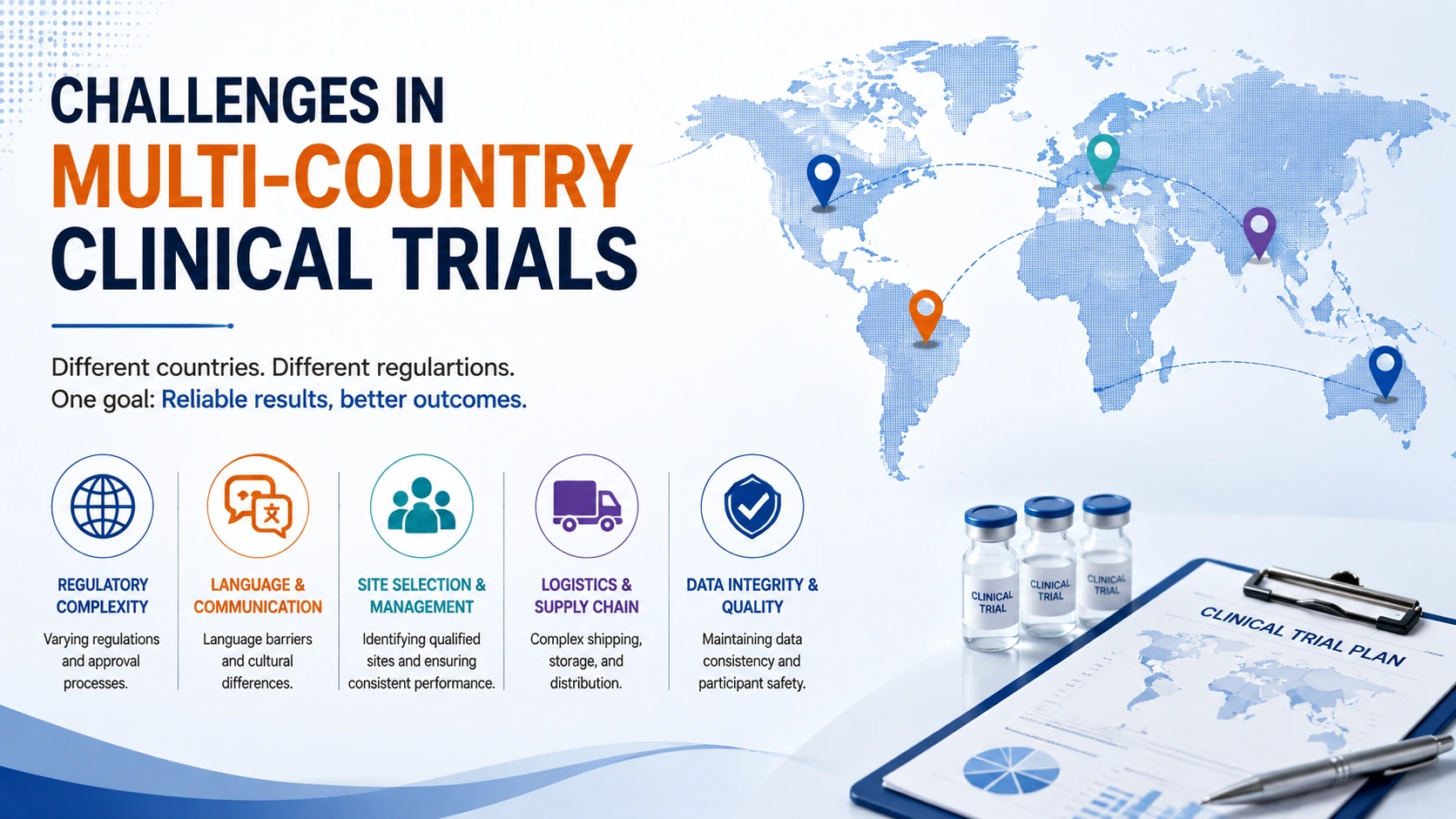
Challenges in Multi-Country Clinical Trials
admin2026-09-01T14:48:08+05:30A multi-country clinical trial that runs smoothly is a triumph of co-ordination across regulatory systems, healthcare infrastructures, languages, cultures, and time zones simultaneously. When it goes wrong, it can go wrong in a dozen directions at once.
The promise of running trials across multiple countries is significant: access to larger and more diverse patient populations, faster recruitment through geographic spread, simultaneous regulatory submissions in multiple markets, and the ability to generate data that is generalisable across global populations. But each of these advantages comes with a corresponding operational complexity.
In 2026, with emerging markets accounting for an increasing share of global trial starts, AI-powered tools reshaping operations, and updated regulatory frameworks demanding greater sponsor accountability, the challenge profile of multi-country trials has evolved substantially.
This guide examines the most significant challenges in multi-country clinical trials in 2026 and the practical approaches that experienced sponsors and CROs use to overcome them.
Quick Answer
The core challenges in multi-country clinical trials fall into six categories: regulatory fragmentation across jurisdictions, patient recruitment and population diversity, data management and cross-border privacy compliance, site and investigator performance variability, operational complexity and system integration burden, and cultural and linguistic barriers. No single solution addresses all of these simultaneously; overcoming them requires a combination of rigorous upfront planning, local expertise, standardised systems, and adaptive risk management.
The Scale of Multi-Country Trial Complexity
Multinational clinical trials can accelerate drug approval processes, expand sample sizes, and improve the representativeness of results. However, cross-border collaborations face challenges in terms of cultural, legal, and ethical issues. Different countries have varying requirements for trials, and standards for data management and ethical review differ, presenting higher demands for global cooperation.
A Phase III trial running across 20 countries may involve:
- 20 separate regulatory authority submissions, each with different content and format requirements
- 20 or more independent ethics committee or institutional review board processes
- Dozens of site contracts in different legal jurisdictions with different negotiating norms
- Patient-facing materials in 15 or more languages
- Data privacy compliance with five or more different regulatory frameworks
- Laboratory samples flowing across international borders, each subject to import and export regulations
- Trial supply chain logistics spanning multiple climate zones and cold chain requirements
Managing all of this coherently without compromising data integrity, participant safety, or regulatory compliance is the operational challenge that defines global clinical development.
Challenge 1: Regulatory Fragmentation Across Jurisdictions
This remains the most universally cited challenge in multi-country trials and has, if anything, become more complex in 2026 as regulatory frameworks continue to evolve independently.
The approval timelines and submission processes differ considerably between agencies such as the FDA, the EMA, Japan’s PMDA, and China’s NMPA. These differences create a fragmented regulatory landscape that can delay trial initiation and complicate the approval of trial designs that need to comply with multiple sets of rules simultaneously.
Specific regulatory divergence points in 2026:
The EU’s Clinical Trials Regulation (CTR 536/2014) and its CTIS submission portal intended to harmonise EU trial approvals have delivered mixed results in practice. cite While the time to regulatory and ethical approval has improved since the implementation of the new regulation, the timelines for approvals are still unacceptably slow, particularly for studies being conducted in the context of an evolving outbreak. There is evidence of conflicting application requirements, increased document burden, barriers to submitting important modifications, and debilitating technical hurdles.
The FDA’s 2024 final guidance on decentralised clinical trials established that regulatory requirements for decentralised elements are identical to traditional on-site requirements, providing needed clarity, but adding complexity for sponsors designing hybrid protocols that must simultaneously satisfy FDA, EMA, MHRA, and PMDA expectations.
New EU Health Technology Assessment regulations require companies to submit assessments within strict 90-day deadlines while managing complex multi-country clinical data requirements.
How leading sponsors address this:
- Designate a regulatory strategy lead responsible for mapping all country-specific requirements at the protocol design stage, not after protocol finalisation
- Use regulatory intelligence platforms that track real-time changes in submission requirements and approval timelines by country
- Build country sequencing into the operational plan based on regulatory approval speed, launching recruitment in fast-approval countries (Australia, UK, Canada) while awaiting approvals in more complex jurisdictions
- Maintain a regulatory correspondence log that tracks all communications with each authority, ensuring consistent responses across jurisdictions when similar queries arise
Challenge 2: Patient Recruitment Across Diverse Populations
Recruitment is the most common reason multi-country trials miss their timelines, and the problem is multidimensional in an international context.
Population heterogeneity creates both an opportunity and a challenge. Recruiting a genetically and demographically diverse patient population improves the generalisability of trial results and now satisfies regulatory diversity requirements from the FDA and EMA. But it also means clinical endpoints, disease presentations, and standard-of-care comparators may differ across countries, creating protocol design complexity and, in some cases, requiring country-specific adaptations that must be approved by each jurisdiction.
Investigator self-reporting inaccuracy remains a structural problem in global feasibility. Sites consistently overestimate their patient pools and recruitment rates during the feasibility phase. The gap between forecasted and actual enrolment rates is one of the most persistent and costly patterns in global clinical research.
Patient awareness and cultural attitudes vary substantially across geographies. Trial participation rates differ not just because of patient availability but because of cultural attitudes toward clinical research, trust in medical institutions, and awareness of trial opportunities. In some markets, community-based engagement and patient advocacy partnerships are essential recruitment tools; in others, physician referral networks are the primary channel.
Digital recruitment in emerging markets offers significant potential, but internet access, smartphone penetration, and digital health literacy vary enormously across countries in the same trial.
Solutions:
- Use real-world data and trial registry analysis to model actual, not self-reported patient availability at potential sites
- Build country-specific recruitment plans that reflect local healthcare pathways rather than applying a uniform global approach
- Partner with patient advocacy organisations in each country before activation they are typically the most effective recruitment channel for rare diseases and complex chronic conditions
- Implement decentralised trial elements (remote consent, remote visits, home nursing) where local infrastructure supports them, to reduce participation burden and expand geographic reach within each country
Challenge 3: Data Management, Harmonisation, and Cross-Border Privacy
Clinical data flowing across international borders in 2026 is subject to a more complex web of privacy regulations than at any point in the history of clinical research.
Multicenter trials commonly involve large sample sizes, centralised coordination, stratified randomisation, and differences in site protocols, patient demographics, outcome measurements, and regulatory environments that contribute to data variability and complexity.
The data harmonisation problem arises because sites in different countries collect data using different instruments, different units of measurement, and different standard-of-care procedures. A haemoglobin value reported in g/dL in the US may be reported in mmol/L in parts of Europe. An endpoint assessed by one validated instrument in one country may require a different validated instrument in another due to availability or language validation status.
Data privacy fragmentation compounds this. The major frameworks relevant to global trials in 2026 include:
- GDPR (EU and UK) – requires explicit consent for processing of special category health data, Data Processing Agreements with all processors, and restrictions on data transfers outside the EEA
- DPDP Act (India) – India’s Digital Personal Data Protection Act introduces consent requirements and data localisation considerations for health data
- HIPAA (United States) – governs protected health information with specific research exemptions that must be carefully applied
- Privacy Act 1988 / Australian Privacy Principles (Australia) regulates health information with research-specific provisions
- PIPL (China) – China’s Personal Information Protection Law has strict data localisation requirements and significant penalties for non-compliance
Running a single trial across all five of these jurisdictions simultaneously requires a privacy compliance framework that satisfies all five, which in several cases means satisfying the most restrictive requirement across all sites, or implementing country-specific consent documents and data handling procedures.
Solutions:
- Implement CDISC data standards from protocol design: CDASH for collection, SDTM for regulatory submission, to enable harmonised data across all sites from the start
- Conduct a privacy impact assessment covering all applicable jurisdictions at study startup
- Work with local data protection experts in each country to validate consent documents and data processing agreements
- Use validated, multilingual eCOA (Electronic Clinical Outcome Assessment) instruments to ensure outcome measurement consistency
- Maintain a Data Management Plan that addresses both CDISC compliance and jurisdiction-specific privacy requirements
Challenge 4: Site and Investigator Performance Variability
In a single-country trial, the performance range across 20 sites is significant. In a 20-country trial with 100 sites, the performance variability is enormous and much harder to manage because the causes of underperformance differ by country.
Causes of site underperformance vary by geography:
- Investigator capacity – overloaded investigators with too many concurrent trials
- Site infrastructure – inadequate pharmacy storage, laboratory equipment, or EHR compatibility
- Staff turnover – high CRC (Clinical Research Coordinator) turnover at sites in some markets disrupts protocol adherence and data quality
- Regulatory interpretation – sites in some countries interpret protocol requirements differently from the global standard
- Data entry culture – query response timelines vary dramatically by country, affecting database lock timelines
Solutions:
- Use centralised statistical monitoring to identify underperforming sites early; anomalous data patterns are often visible before a traditional monitoring visit would catch them
- Conduct site performance reviews at governance meetings using KPIs specific to each country’s context
- Invest in site training beyond GCP certification: therapeutic area training, protocol walkthroughs, and ongoing case-based education improve protocol adherence materially
- Build graduated response protocols for underperforming sites: early coaching, then increased monitoring frequency, then site pause or replacement as escalating responses
- Assign country managers with direct local language capability and cultural knowledge; managing site relationships remotely and cross-culturally through a central project manager alone does not work effectively
Challenge 5: Operational Complexity and Technology Integration
Strategic partnerships and functional standardisation are essential for reducing variability and supporting site operations across diverse regions. Sites under strain: system and process switching emerges as a central operational risk.
In 2026, a multi-country trial may deploy six or more technology systems across its sites: EDC, IWRS, eTMF, eConsent, remote monitoring platforms, patient-facing apps, and wearable device integrations. Each system requires site training, technical validation, and ongoing support. When systems change during a trial a growing phenomenon as sponsors switch vendors or upgrade platforms the operational disruption at the site level is severe.
Specific operational complexity drivers:
- Time zone management – real-time safety reporting, SAE processing, and sponsor escalation pathways must function across time zones that may span 18 hours
- Language management – protocol documents, patient materials, training materials, and CRF instructions must be professionally translated, back-translated, and validated in every study language
- Supply chain and cold chain logistics – investigational product distribution across international borders involves import licenses, customs clearance, temperature monitoring, and depot management in each country
- Local laboratory standards – reference ranges for laboratory values differ across countries, requiring careful normal range harmonisation in the statistical analysis plan
Solutions:
- Select technology platforms with established multilingual support and interoperability with common sponsor systems before trial start
- Build a technology change management process: site notification, re-training, parallel running periods that are triggered whenever a system change occurs during the trial
- Centralise SAE processing in a single time zone with documented handover protocols for regional coverage
- Work with a single global supply chain vendor for IMP logistics rather than managing country-specific distributors independently
- Conduct a centralised laboratory harmonisation exercise at study startup to document normal range differences and their statistical treatment
Challenge 6: Cultural and Linguistic Barriers
Cultural and linguistic barriers affect every layer of multi-country trial operations and are consistently underestimated by sponsors with limited international trial experience.
Informed consent is perhaps the area of greatest cultural sensitivity. In some cultures, individual autonomous consent is well-established. In others, family-based decision-making or community leader involvement is the social norm, and a consent process designed for one cultural context may be ineffective or ethically inappropriate in another.
Investigator communication norms vary significantly. In some cultures, investigators will clearly escalate concerns to the CRO or sponsor. In others, concerns are communicated indirectly or not at all until they become significant problems. Country managers who understand these norms and who communicate in the local language catch issues that a cross-cultural, English-only management approach misses.
Patient-facing materials require genuine linguistic adaptation not just literal translation. Medical terminology, health literacy levels, and visual communication norms differ across countries and must be addressed through professional translation, cultural adaptation review, and back-translation validation.
Solutions:
- Engage cultural consultants with clinical research experience in each country during protocol and consent form design
- Use qualitative patient feedback during consent form development to assess comprehension and cultural appropriateness before regulatory submission
- Hire country managers and CRAs who are native speakers of the dominant local language, not just English speakers with regional responsibility
- Build cultural competency training into site onboarding alongside GCP and protocol training
2026 Developments Changing the Challenge Landscape
AI-Powered Risk Identification is reducing the impact of site variability and data quality challenges by identifying problems earlier and more systematically than human monitoring alone.
Decentralised trial infrastructure is reducing participation burden in geographies with limited site networks but introduces new challenges around remote monitoring validation and technology equity.
Harmonisation pressure from major markets – the FDA, EMA, and PMDA are increasingly collaborating through multilateral frameworks to align requirements for globally conducted trials, reducing (slowly) the regulatory fragmentation burden.
Frequently Asked Questions
Regulatory fragmentation, patient recruitment shortfalls, cross-border data privacy compliance, site performance variability, technology integration complexity, and cultural and linguistic barriers all operate simultaneously.
Investigator self-reporting inaccuracy during feasibility, treating site activation as a single milestone, uniform recruitment strategies across markets with different patient access pathways, and underinvestment in community and patient advocacy partnerships.
GDPR (EU/UK), HIPAA (US), DPDP Act (India), Privacy Act (Australia), and PIPL (China) plus any country-specific laws in each trial country. All applicable frameworks must be satisfied simultaneously.
Consent processes, investigator communication norms, patient material comprehension, and community trust in research all differ significantly by country. Addressing this requires native-speaking country managers, culturally adapted materials, and country-specific community engagement strategies.
Conclusion
Multi-country clinical trials carry exceptional operational complexity, but that complexity is navigable with the right combination of upfront planning, local expertise, technology infrastructure, and adaptive risk management.
The sponsors and CROs achieving the best outcomes in global trials in 2026 share a common characteristic: they treat local expertise not as a cost to be minimised but as a strategic asset that makes everything else work. They invest in country managers who speak the local language, community partnerships that are established before the first patient is approached, and regulatory strategies that are built into the protocol from the beginning.
The challenges documented in this guide are real, predictable, and with the right preparation, manageable. The key is anticipating them before they become delays, rather than reacting to them after the damage is done.




Leave a Reply