
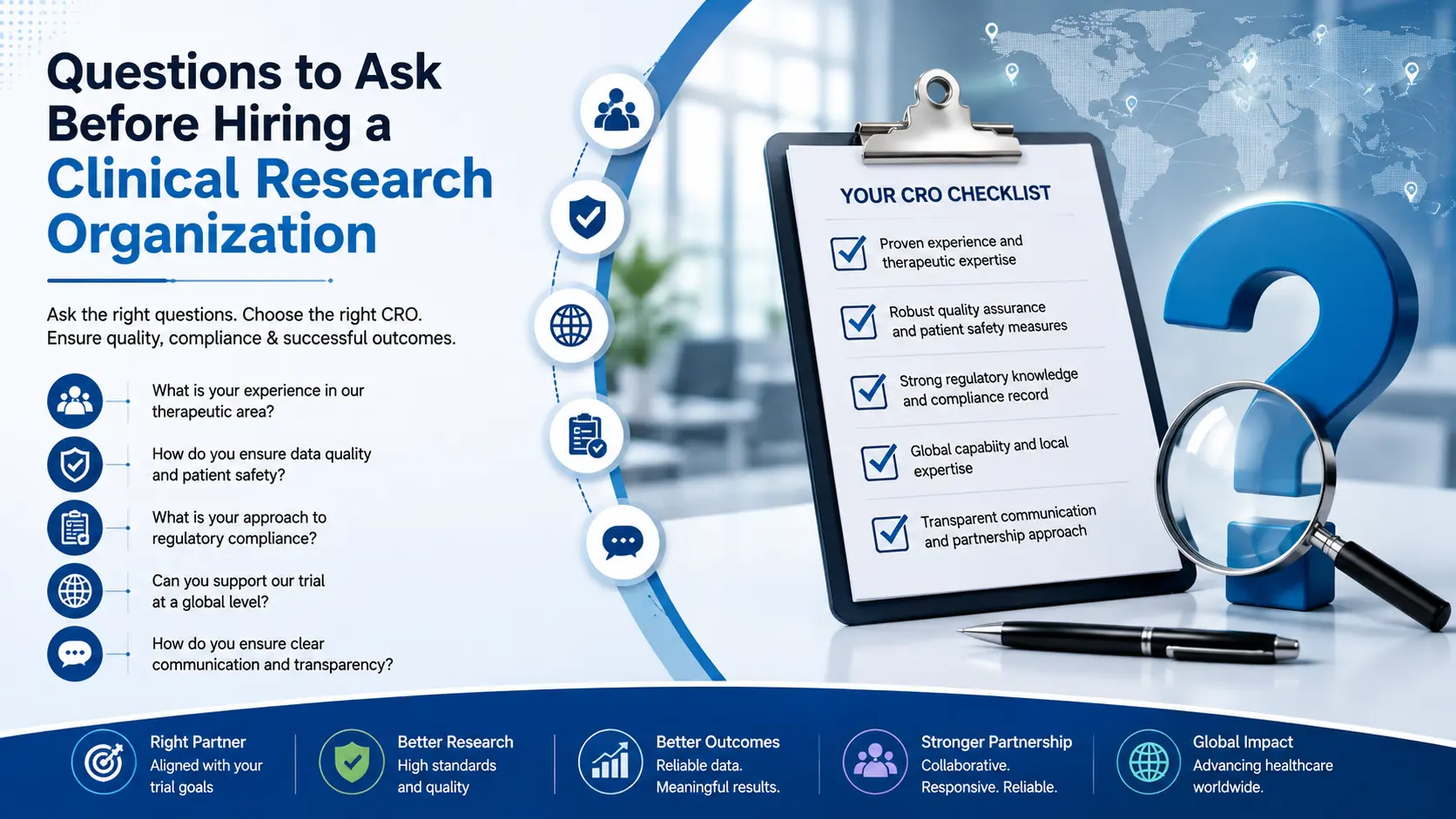
20 Questions to Ask Before Hiring a Clinical Research Organisation in 2026
admin2026-08-20T09:20:08+05:30Most sponsor organisations know they need to evaluate a CRO before hiring one. Far fewer know exactly which questions to ask and how to interpret the answers.
The difference matters enormously. A CRO will always present its capabilities in the most favourable light during the sales process. The questions you ask, and your ability to probe behind surface-level answers, determine whether you walk away with an accurate picture of what you are actually buying.
This guide provides 20 essential questions to ask before hiring a Clinical Research Organisation, organised by category, with guidance on what a strong answer looks like and what warning signs to watch for.
Quick Answer
Before hiring a CRO, ask detailed questions across five domains: therapeutic expertise and experience, regulatory and quality track record, patient recruitment methodology, technology infrastructure, and contract and risk management. Generic or evasive answers are red flags. The goal is to assess not just capability, but cultural fit, transparency, and the CRO’s ability to perform under real-world trial pressure.
Why Due Diligence Questions Matter
Selecting a Clinical Research Organisation is one of the most important decisions a Sponsor will make in the planning and delivery of any clinical trial. The right partner will help ensure your study is well-executed, timelines are maintained, and takes a huge operational weight off your shoulders. A poor fit can result in delays, rising costs, and missed milestones.
The challenge is that due diligence conversations often devolve into capability presentations: the CRO talks, the sponsor listens, and hard questions go unasked. Structured, specific questioning reverses this dynamic. It puts the burden of proof on the CRO and gives you the information needed to make a genuinely informed decision.
Category 1: Therapeutic Expertise and Experience
Question 1: How many trials have you completed in our specific indication, and what were the outcomes?
What a strong answer looks like: A specific list of completed trials by phase and indication, with measurable outcomes: recruitment rate versus target, timeline adherence, data quality metrics. The CRO can name the therapeutic specialists on those trials and confirm their availability for your programme.
Red flag: General references to therapeutic “area” experience without specific indication data. Claiming oncology experience when your indication is a rare haematological malignancy is not the same thing.
Question 2: Who specifically would lead and manage our trial, and what are their qualifications?
What a strong answer looks like: Named individuals: a Medical Monitor, Project Manager, and Lead Clinical Research Associate with CVs and direct experience in your indication. The CRO confirms these individuals are available and will not be reassigned without sponsor notification.
Red flag: The presentation team consists entirely of business development staff. You are told, “the team will be assigned after contract signature.” This is one of the most common and costly mistakes sponsors make. The team presented during sales is rarely the team that runs the trial.
Question 3: Can you provide three references from sponsors who completed trials of similar complexity in this indication?
What a strong answer looks like: Three specific, contactable references, not a general list of well-known clients who ran comparable trials and are willing to discuss specifics, including challenges and how they were resolved.
Red flag: References are provided only after contract signature, or reference calls are managed by the CRO’s business development team rather than independently arranged by the sponsor.
Category 2: Regulatory and Quality Track Record
Question 4: What is your regulatory inspection history for the last five years? What findings were received and how were they resolved?
What a strong answer looks like: A clear summary of inspections by agency (FDA, EMA, MHRA, TGA), findings categorised by severity, and documented CAPA resolution for each. The CRO is comfortable sharing this proactively.
Red flag: Reluctance to share inspection history, vague descriptions of “minor observations,” or unresolved critical findings with no clear remediation timeline.
Question 5: How does your Quality Management System ensure data integrity across all trial functions?
What a strong answer looks like: A description of validated systems, documented SOPs for all trial activities, audit trail capabilities, deviation management workflows, and a defined process for escalating data quality issues to the sponsor in real time.
Red flag: A QMS described in broad terms without specifics on how deviations are tracked, or no defined SLA for sponsor notification of significant findings.
Question 6: How do you implement ICH GCP E6(R3) risk-based quality management in practice?
This question distinguishes CROs that have genuinely implemented RBQM from those that use it as a marketing term. A credible answer describes: central statistical monitoring, a defined risk threshold for on-site versus remote monitoring decisions, and a documented risk management plan that is customised for each protocol.
Red flag: An answer that conflates RBQM with “reduced monitoring” without describing the analytical framework that underpins monitoring decisions.
Question 7: What is your process for managing and reporting serious adverse events (SAEs) and protocol deviations?
Regulatory compliance in clinical trials lives or dies in SAE and deviation management. A strong CRO has a defined, time-bound workflow for SAE reporting that meets the most stringent applicable regulatory requirements (typically 7 days for expedited reports) and a clear escalation pathway that includes direct sponsor notification.
Red flag: SAE reporting timelines that are vague or dependent on site-level reporting without CRO-level oversight and reconciliation.
Category 3: Patient Recruitment and Site Network
Question 8: What is your recruitment methodology for this indication, and how does it differ from a standard site-based approach?
A top network must have direct, proven access to large and diverse patient populations, not just a list of sites, but active relationships with the communities those sites serve.</cite>
What a strong answer looks like: A specific methodology that includes digital patient identification, decentralised recruitment tools, community partnership programmes, and patient advocacy group relationships relevant to your indication, not a generic recruitment pitch.
Red flag: Recruitment methodology described entirely in terms of site activation and investigator relationships, with no digital or community-based components.
Question 9: What is your historical recruitment rate versus forecasted rate on the last five comparable studies?
This is the most revealing single recruitment question. A CRO confident in its recruitment performance will share actual data: percentage of sites meeting enrolment targets, number of studies with protocol-mandated timeline extensions due to recruitment, and average deviation between forecast and actual enrolment rates.
Red flag: “We always meet our timelines” without data. Or data that only covers the last one or two studies.
Question 10: How do you ensure diversity in patient recruitment, and what does your DEI recruitment strategy look like?
Regulatory guidance from the FDA (2023 Diversity Action Plan requirement) and EMA increasingly requires sponsors to demonstrate diverse trial populations. A CRO with an established DEI recruitment framework, community health partnerships, language-adapted materials, and culturally competent site staff provides a material regulatory advantage.
Red flag: DEI treated as a compliance checkbox rather than an embedded recruitment strategy.
Category 4: Technology and Data Infrastructure
Question 11: What technology platform will be used for data management, and what access will we have as a sponsor?
What a strong answer looks like: A named, validated EDC platform with real-time sponsor dashboard access, centralised statistical monitoring capability, and a defined data cleaning timeline. The CRO confirms data portability: you can extract your data at any time and at trial end in a standard format.
Red flag: Sponsor access described as periodic reports rather than real-time dashboard visibility. Proprietary data formats that complicate extraction.
Question 12: How do you manage decentralised or hybrid trial components, and what remote monitoring capabilities do you offer?
In 2026, trials that cannot accommodate remote patient participation face meaningful recruitment limitations. Ask specifically about: eConsent platform, telehealth visit capabilities, home nursing partnerships, wearable device data integration, and how remote data is validated.
Red flag: Decentralised capabilities described as “being developed” or “available through third-party partners” without established integration and validation.
Question 13: How do you use AI or machine learning in trial operations, and what specific tools are deployed?
CROs are shifting from outsourced vendors to strategic co-developers, with advanced data tools, AI, regulatory expertise and integrated services helping sponsors accelerate drug development.
Ask for specific AI applications: patient identification algorithms, site performance prediction, risk-based monitoring triggers, and regulatory submission support. Ask which tools are proprietary versus third-party, and what validation has been performed.
Red flag: AI described in aspirational terms without named tools, validation evidence, or specific operational use cases.
Category 5: Project Management and Communication
Question 14: What is your governance structure for this programme, and how are escalation decisions made?
A well-defined governance structure includes: a Joint Steering Committee with defined meeting cadence, a named point of escalation for sponsor-side and CRO-side project issues, and documented decision-making authority at each management tier.
Red flag: Governance described informally. No documented escalation pathway. Sponsor access limited to the project manager rather than senior operational leadership.
Question 15: How do you handle scope changes and what is your change order process?
Scope changes are inevitable in clinical Research. How a CRO manages them speed, transparency, and cost discipline is a major determinant of overall budget performance. Ask for examples of change orders from previous studies: how quickly were they raised, how were costs calculated, and how were disputes resolved?
Red flag: A CRO that is vague about change order triggers or that presents an initial bid significantly below competitors without explaining how scope variances will be handled.
Question 16: What is your staff retention rate in project management and clinical operations roles?
High staff turnover during a trial is one of the most disruptive events a sponsor can experience. Key relationship continuity, institutional knowledge, and operational momentum are all at risk when project managers or CRAs change mid-study.
Red flag: Turnover rates above 20% annually in operational roles. No contractual commitment to notify the sponsor when key staff are changed.
Category 6: Risk Management and Contingency Planning
Question 17: How do you identify and manage risks specific to this trial, and can you share your risk management framework?
Every trial carries unique risks: geographic, regulatory, population-specific, and protocol complexity risks. A mature CRO conducts a formal risk assessment at study start, maintains a living risk register, and reviews it at governance meetings.
Red flag: Risk management described as “reactive” issues are identified and addressed when they arise rather than systematically anticipated and planned for.
Question 18: What is your business continuity plan, and how have you managed major operational disruptions in the past?
The COVID-19 pandemic was a forcing function for CRO resilience. Ask specifically how the CRO managed active trials during operational disruption, what decentralised capabilities were activated, how site closures were managed, and what the sponsor experience was like.
Red flag: No documented business continuity plan. No evidence of operational flexibility during past disruptions.
Category 7: Financial and Contractual Terms
Question 19: What are your payment milestone terms, and how are pass-through costs managed?
Payment structure affects sponsor cash flow and CRO incentive alignment. Milestone-based payments tied to study start, enrolment milestones, database lock, and regulatory submission align CRO incentives with trial progress. Understand exactly what triggers each payment and how pass-through costs (site payments, lab fees, travel) are invoiced and reconciled.
Red flag: Front-loaded payment schedules that transfer financial risk to the sponsor before meaningful deliverables have been achieved.
Question 20: What Key Performance Indicators will be tracked, and what are the consequences of underperformance?
KPIs without consequences are aspirations. A serious CRO agrees to measurable KPIs: enrolment rate, data entry timelines, query response rates, protocol deviation rates, and accepts financial consequences (typically credit mechanisms) for sustained underperformance.
Red flag: A CRO that agrees to KPIs but resists any financial consequence mechanism. This signals low confidence in their own performance targets.
How to Use These Questions Effectively
Do not read these questions from a list during a CRO presentation. Build them into a structured evaluation process:
- Include the most critical questions in your RFP as written response requirements
- Reserve deep-dive questions for capability presentations with the operational team
- Use reference calls to validate the answers you received; ask references whether the CRO’s self-description matched their experience
- Document all answers and score them against your selection criteria consistently across all CRO candidates
Frequently Asked Questions
Evaluate five to eight at RFP stage and shortlist two to three for deep-dive presentations. Fewer than three risks missing a better fit; more than eight creates disproportionate administrative burden.
Accepting the sales team’s presentation as representative of the operational team. Always insist on meeting the specific individuals who will manage your trial before contract signature.
Absolutely. Under ICH GCP E6(R3), you are responsible for the quality of outsourced activities; a CRO’s inspection history is effectively your regulatory track record. Refusal to share it is a significant red flag.
Very and frequently underestimated. Trials require hundreds of escalations and course corrections over months. Cultural misalignment generates friction at every step, even when both parties are technically competent.
Enrolment rate versus target, data query resolution timelines, protocol deviation rate, SAE reporting compliance, and site activation adherence each with a defined threshold and financial consequence for sustained underperformance.
Conclusion
The twenty questions in this guide are not a formality; they are a due diligence framework that separates sponsors who select on capability claims from those who select on verified performance evidence.
The most valuable CRO relationship is one where hard questions were asked upfront, honest answers were given, and expectations were set in writing before the first patient was enrolled.
Going into a CRO evaluation? Use these questions as your structured guide and remember: a CRO confident in its performance will welcome every one of them.

Leave a Reply