
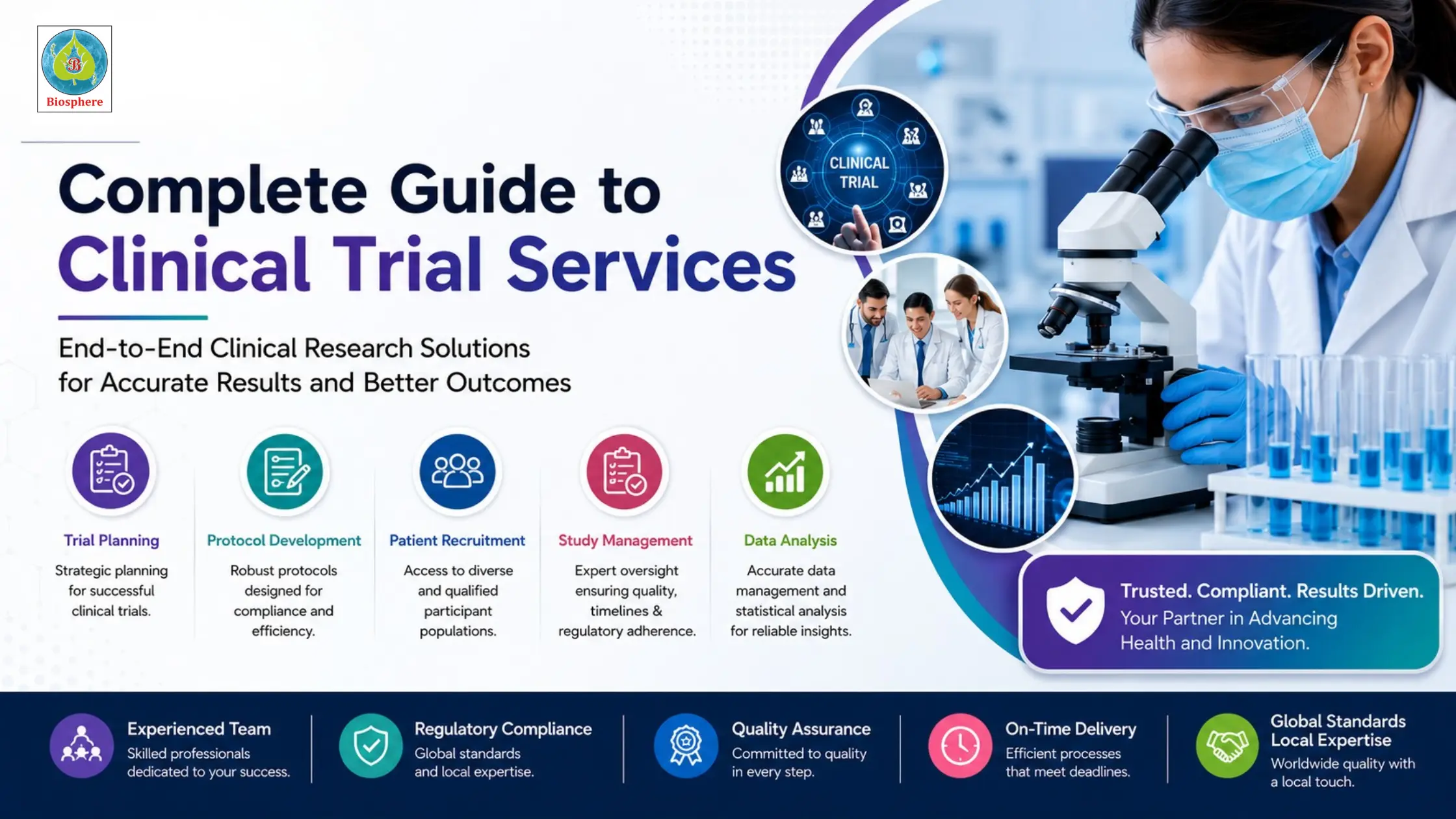
Complete Guide to Clinical Trial Services for Sponsors
admin2026-10-08T15:21:18+05:30If you’ve spent any time evaluating a clinical research organisation, you’ve probably noticed a pattern: most websites describe what a CRO is in almost identical language, then list services without explaining how those services connect to each other or why the order matters. That gap is where a lot of sponsors particularly first-time sponsors, academic groups, and smaller biotech and device companies get stuck. They know they need “clinical trial services,” but not which services, in what sequence, or what questions to ask before signing a contract.
This guide walks through the actual mechanics of clinical trial support: how a study moves from protocol to database to regulatory submission, where medical writing and biostatistics fit into that timeline, and what separates a CRO that merely executes tasks from one that catches problems before they become delays. It’s written for people evaluating a CRO for the first time, or reassessing a current partner, rather than for readers who already work inside clinical operations.
What a Clinical Research Organisation Actually Does
A clinical research organisation is a contracted partner that manages some or all of the operational, regulatory, and scientific work involved in running a clinical trial, so that the sponsor a pharmaceutical company, medical device manufacturer, biotech firm, or academic institution doesn’t have to build that capability in-house. The scope can be narrow (just data management, for instance) or full-service, covering everything from protocol design through the final clinical study report.
What tends to separate a strong CRO from an average one isn’t the length of its service list. It’s how well those services are integrated. A trial that has excellent site monitoring but a data management team that isn’t talking to the biostatistics team will still produce a messy dataset. A regulatory submission built without close coordination with the clinical operations team will miss operational details that reviewers flag. The best clinical research organisation for a given sponsor is usually the one whose teams function as a single coordinated unit rather than separate departments that happen to share a logo.
The Core Categories of Clinical Trial Services
Most clinical trial services fall into five interconnected categories:
- Study start-up and clinical operations – site identification, ethics committee submissions, contracts, and the day-to-day management of sites once the trial is active.
- Data management – building the tools and processes that turn what happens at a clinical site into a clean, analysable dataset.
- Biostatistics – the statistical design and analysis that turns that dataset into a defensible answer to the trial’s research question.
- Medical writing – the documents that explain the trial’s design, conduct, and results to regulators, ethics committees, and, eventually, physicians and patients.
- Regulatory affairs – the submissions, approvals, and ongoing regulatory correspondence that keep the trial (and eventually the product) compliant.
These aren’t sequential silos so much as overlapping workstreams that need to stay in sync from day one. A change in the data collection plan affects the biostatistics analysis plan, which affects what the medical writers can say in the clinical study report, which affects what goes into the regulatory submission. Sponsors who understand this interdependence tend to ask much better questions during CRO selection.
Clinical Trial Data Management: Where Quality Is Won or Lost
Data management is often treated as a back-office function, but it’s arguably where trial quality is decided. Every downstream output statistical analysis, safety reporting, the final study report depends on the integrity of the data captured at the point of care.
CRF Designing and eCRF Designing
The case report form, or CRF, is the document (paper or electronic) used to record every data point specified in the trial protocol for each participant. CRF designing is deceptively hard: a form that’s too long increases site burden and error rates; a form that’s too short misses data the statisticians will need later. Good CRF design starts from the statistical analysis plan, not the protocol text, because the analysis plan tells you precisely which variables, in which format, will actually be used.
eCRF design: building that same form inside an electronic data capture (EDC) system adds another layer of consideration: edit checks, skip logic, auto-calculations, and validation rules that catch errors as they’re entered rather than weeks later during a data review. A well-built eCRF reduces query volume significantly, which directly shortens database lock timelines.
Clinical Database Design
Behind every eCRF sits a clinical database, the structured repository that stores, validates, and organises trial data so it can be exported into a format statisticians and regulators can use. Clinical database design decisions made early (data structure, coding dictionaries such as MedDRA and WHO-DD, audit trail configuration) are difficult and costly to change mid-study. This is one area where experience matters more than tooling: a database built by a team that has handled CDISC-compliant submissions before will look noticeably different from one built without that context, even if both technically “work.”
Biostatistics Services and Clinical Trial Statistical Analysis
Biostatistics services touch a trial at three distinct points, and sponsors sometimes only think about the last one.
- Design stage: sample size calculation, randomisation scheme, and the statistical analysis plan (SAP), the document that pre-specifies exactly how the data will be analysed, before anyone sees results. This pre-specification is what protects a trial’s findings from accusations of after-the-fact data manipulation.
- Conduct stage: interim analyses, data monitoring committee support, and ongoing data review to flag anomalies early.
- Reporting stage: the final clinical trial statistical analysis, including tables, listings, and figures (TLFs) that feed directly into the clinical study report and regulatory dossier.
A biostatistics team that’s involved only at the reporting stage is working with whatever data quality it’s handed. A biostatistics team involved from protocol design onward can influence CRF structure, flag underpowered designs before enrolment starts, and prevent the kind of analysis surprises that delay submissions by months.
Medical Writing Services and Regulatory Medical Writing
Medical writing services cover a wide range of documents: protocols, investigator brochures, informed consent forms, clinical study reports, manuscripts, and safety narratives. Regulatory medical writing specifically refers to documents intended for submission to a health authority, where precision, consistency with the underlying data, and adherence to prescribed formats (such as the Common Technical Document structure) matter more than readability for a general audience.
Good regulatory medical writers work closely with biostatistics and data management, not just with the clinical team, because a clinical study report has to reconcile narrative claims with the actual statistical output line by line, in some cases. Mismatches between what the text says and what the tables show are one of the most common reasons regulators send back queries, which adds months to a submission timeline.
Regulatory Submission and SUGAM Submission
Regulatory submission is the process of formally presenting trial data, protocols, and supporting documentation to a health authority for review, whether that’s for permission to start a trial, approval of a new drug, or post-marketing reporting obligations.
In India, this process runs through SUGAM, the Central Drugs Standard Control Organisation’s (CDSCO) online portal for clinical trial applications, ethics committee registrations, and related submissions. SUGAM submission requires accurate, complete documentation uploaded in the correct format, and delays here are rarely about the science; they’re usually about incomplete forms, missing supporting documents, or applications that don’t match what was actually approved by the ethics committee. A CRO with hands-on SUGAM experience will know the specific documentation patterns CDSCO reviewers expect, which is the kind of practical knowledge that only comes from having filed dozens of these applications, not from reading the regulations.
Remote Monitoring Services and Global Clinical Operations
Site monitoring, the process of verifying that a trial is being conducted according to protocol, that data matches source documents, and that participants are safe, has shifted substantially toward remote models over the past several years. Remote monitoring services use a combination of centralised data review, risk-based monitoring triggers, and video or document-based source verification to reduce the number of in-person site visits without reducing oversight quality.
This matters most for trials with geographically dispersed sites, where flying a monitor to every location for every visit is neither affordable nor necessary for a well-run study. Remote monitoring works best when it’s risk-based, meaning monitoring intensity is matched to site risk indicators (enrolment rate, query rate, protocol deviation history) rather than applied uniformly.
Global clinical operations extends this same coordination challenge across countries: different regulatory timelines, different ethics committee structures, different site capabilities, and different logistics for supplies and shipments. A CRO managing global clinical operations needs local regulatory knowledge in each country involved, not just a central project management function coordinating from one office. This is often where sponsors discover the difference between a CRO that has genuine multi-country experience and one that’s coordinating third-party vendors it doesn’t fully control.
How to Evaluate the Best Clinical Research Organisation for Your Trial
There’s no single “best” CRO; the right fit depends on trial phase, therapeutic area, geography, and how much internal capability the sponsor already has. That said, a few questions tend to separate a strong partner from a risky one:
- Can they show a specific example of a SUGAM (or equivalent) submission they handled, including how they resolved a query from the authority?
- Does their data management team build the eCRF in direct consultation with biostatistics, or are these separate handoffs?
- What’s their actual query resolution rate and average time to database lock on comparable trials?
- How do they structure remote monitoring? Is it risk-based, or a fixed schedule applied to every site regardless of performance?
- Who writes the clinical study report, and do they work from the locked database or from draft data?
Sponsors who ask these operational questions, rather than relying on a services list, tend to end up with partners who catch problems early rather than partners who are simply good at explaining, after the fact, why something went wrong.
Frequently Asked Questions
A CRO manages trial operations, data, and regulatory work across one or many sites, often across multiple countries. A clinical trial site is the physical location a hospital, clinic, or research centre where participants are actually enrolled, assessed, and treated according to the protocol.
A full-service CRO usually covers clinical operations and site monitoring, clinical trial data management (including CRF and eCRF designing), biostatistics and statistical analysis, medical writing, and regulatory submission support, managed as one coordinated programme rather than separate contracts.
SUGAM is CDSCO’s online portal in India for clinical trial applications, ethics committee registrations, and related regulatory submissions. Sponsors running trials in India, or seeking drug or device approval through CDSCO, need to submit and track applications through this system.
A CRF (case report form) is the document used to record trial data for each participant, historically on paper. An eCRF is the same form built inside an electronic data capture system, with built-in validation checks that catch data errors as they’re entered rather than during a later review.
Sample size, randomisation, and the statistical analysis plan all have to be defined before enrolment begins, both to ensure the trial can actually answer its research question and to prevent accusations that the analysis approach was chosen after seeing the results.
Remote monitoring uses centralised data review and, where appropriate, video or document-based verification instead of routine in-person site visits. It’s typically combined with risk-based triggers, so monitoring intensity increases for sites showing data or compliance issues rather than applying the same visit schedule to every site.
Direct evidence of experience with the specific regulatory pathway involved (such as CDSCO/SUGAM for India), how closely the data management and biostatistics teams work together, actual track record on query resolution and database lock timelines, and how monitoring intensity is determined rather than relying on a general services list.
Biosphere CRO | www.biospherecro.com | End-to-End Clinical Research Services
Interested in working or gaining experience in clinical research? Explore career opportunities with Biosphere CRO.



Leave a Reply