

Clinical Research Explained in 5 Minutes (Beginner Guide)
admin2026-10-08T14:24:49+05:30What is a CRO? Complete Guide for Beginners (2026)
By 2026, more than 70 percent of clinical trials worldwide will involve a clinical research organisation in some capacity. Pharmaceutical pipelines have never been more crowded, biotech startups are scaling faster than ever, and regulators are raising the bar on data quality and patient safety. In this environment, partnering with the right CRO is no longer a cost decision. It is a strategic one.
If you are exploring CRO services for the first time, this complete beginner guide explains exactly what a CRO is, why pharmaceutical companies hire one, and how AI is reshaping clinical trial outsourcing in 2026.
What is a CRO in Clinical Research?
A CRO, short for Clinical Research Organisation, is a specialised service company that runs clinical trials and related research activities on behalf of pharmaceutical, biotechnology, and medical device sponsors.
Think of a CRO as the operational engine behind drug development. Sponsors bring the science and the molecule. The CRO brings the people, processes, technology, and regulatory know how to test it in human volunteers safely, ethically, and at scale.
Quick Answer
CRO (Clinical Research Organisation) is a specialised service provider that runs clinical trials for pharmaceutical, biotech, and medical device companies. CRO services include trial design, regulatory submission, data management, biostatistics, monitoring, medical writing, and global clinical operations.
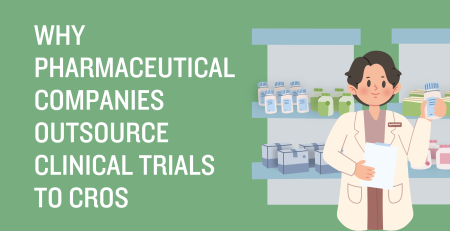
Why Pharmaceutical Companies Hire CROs
Drug development is long, complex, and expensive. The average new drug now costs more than USD 2.3 billion and takes over a decade to reach the market. CROs help sponsors compress timelines, control costs, and reduce risk.
Key reasons pharmaceutical and biotech companies outsource to CROs in 2026:
- Outsourcing as the default model: more than two thirds of global clinical trial spend now flows through CROs.
- Cost savings: variable cost models replace expensive in house infrastructure.
- Faster trial timelines: established site networks shorten startup and recruitment cycles.
- Global expertise: access to investigators and patient populations across regions in a single contract.
- Regulatory support: ready expertise in FDA, EMA, MHRA, PMDA, and CDSCO frameworks.
- Specialised capability: biostatistics, pharmacovigilance, and decentralised trial technology that is hard to build internally.
Core Clinical Trial Services Offered by CROs
Top CROs operate as full service partners. The most commonly outsourced clinical trial services include:
Medical Writing Services
Medical writing converts scientific data into structured, regulator ready documents. Deliverables include protocols, investigator brochures, clinical study reports, patient narratives, and safety summaries.
Regulatory Medical Writing
Regulatory medical writing is a specialised discipline that builds the documents required for submissions to global health authorities. These include modules of the Common Technical Document (CTD), responses to regulator queries, and periodic safety reports.
Regulatory Submission and Sugam Submission
CROs manage end to end regulatory submission, including IND, NDA, and CTA filings. In India, this includes Sugam submission through the CDSCO online portal for clinical trial applications, import licences, and post approval changes.
Clinical Trial Data Management
Clinical trial data management ensures that every data point captured during a study is accurate, complete, and audit ready. Activities span database design, data entry oversight, query management, and database lock.
CRF Designing and eCRF Designing
CRF designing creates the templates used to record trial data. eCRF designing builds the electronic versions used in modern EDC platforms. Well designed forms reduce site burden and improve data quality.
Clinical Database Design
Clinical database design defines the structure, validation rules, and edit checks of the trial database. A robust design prevents downstream cleaning headaches and accelerates the path to database lock.
Biostatistics Services
Biostatistics services define how trial data will be analysed and interpreted. Activities include sample size calculation, randomisation, statistical analysis plans, and final inference reporting.
Clinical Trial Statistical Analysis
Clinical trial statistical analysis applies validated programming in SAS and R to produce the tables, listings, and figures that underpin the Clinical Study Report and regulatory submissions.
Remote Monitoring Services
Remote monitoring services use risk based, centralised, and virtual oversight to monitor trial conduct without constant on site visits. This model is core to decentralised clinical trials.
Global Clinical Operations
Global clinical operations coordinate trials across multiple countries, managing logistics, site activation, project management, and local regulatory coordination at scale.
AI and Digital Transformation in Clinical Research
AI in clinical research is no longer experimental. In 2026, AI powered tools are integrated into virtually every layer of the trial workflow:
- AI powered patient recruitment scans electronic health records to identify eligible volunteers in days, not months.
- Predictive analytics forecast enrolment, dropout, and site performance with high accuracy.
- Digital patient recruitment platforms combine social, search, and clinical data for precise targeting.
- Remote patient monitoring through wearables and apps feeds real time data into trial databases.
- Decentralised clinical trials use telemedicine, home nursing, and connected devices to bring trials to patients.
- Automation in data management cleans and codes data continuously rather than in periodic cycles.
Sponsors who adopt these digital trial capabilities, ideally through a CRO that already operates them at scale, see faster timelines, better retention, and richer datasets.
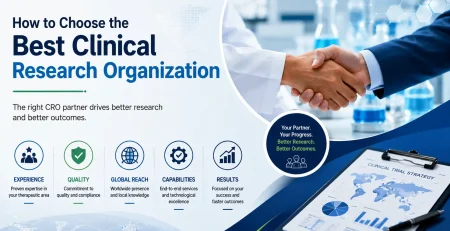
How to Choose the Best Clinical Research Organisation
Choosing the right CRO is one of the highest leverage decisions in any clinical programme. Use this checklist when evaluating partners:
- Compliance standards: GCP, ICH, 21 CFR Part 11, GDPR, and local regulatory adherence.
- Global reach: presence and operational experience in your target countries.
- Technology capabilities: modern EDC, eCRF, eConsent, eCOA, RPM, and analytics stack.
- Therapeutic expertise: demonstrated experience in your indication and patient population.
- Data management quality: robust eCRF designing, query management, and database lock track record.
- Scalability: capacity to grow with your study without disruption or quality loss.
- Communication and governance: clear escalation, transparent reporting, and a single accountable lead.
Why Biosphere CRO is a Trusted Global CRO Partner
Biosphere CRO has built its model around the demands of modern, AI enabled, globally distributed clinical research. Sponsors choose Biosphere CRO because the organisation is:
- Scalable: able to flex from early phase studies to large multi country Phase 3 trials.
- Compliant: aligned with ICH GCP, FDA, EMA, and CDSCO requirements.
- Technology driven: modern EDC, secure eCRF, and remote monitoring platforms.
- Globally capable: experienced global clinical operations across regulated markets.
- Quality focused: data integrity, patient safety, and ethical conduct embedded in every SOP.
Conclusion
CROs sit at the centre of modern drug development. They take the operational complexity of running global, AI enabled, regulator ready trials off the sponsor’s plate and convert it into a structured, scalable service. The future of clinical research is decentralised, data driven, and outsourced to partners who can deliver across borders, technologies, and therapeutic areas.
For pharmaceutical companies, biotech startups, and healthcare innovators, the choice of CRO is the choice of how fast, how compliant, and how confident you want your clinical programme to be.
Connect with Biosphere CRO
Build your next trial with a CRO designed for 2026. Biosphere CRO partners with pharmaceutical companies, biotech firms, and healthcare startups to deliver end to end clinical trial services with regulatory depth, modern technology, and global reach. Connect with Biosphere CRO for: • Clinical trial services across all phases • Medical writing and regulatory medical writing • Clinical trial data management and eCRF designing • Biostatistics and clinical trial statistical analysis • Regulatory submission and Sugam submission • Remote monitoring services • Global clinical operations Visit biospherecro.com or contact our team to discuss your study. Discover why sponsors trust Biosphere CRO as their global clinical research partner. |
Frequently Asked Questions
A CRO (Clinical Research Organisation) is a specialised service company that runs clinical trials on behalf of pharmaceutical, biotech, and medical device sponsors. CROs handle trial design, regulatory submission, data management, biostatistics, monitoring, and reporting.
CROs provide a full range of clinical trial services including medical writing, regulatory medical writing, regulatory and Sugam submission, clinical trial data management, CRF and eCRF designing, biostatistics services, remote monitoring services, and global clinical operations.
CROs are important because they let sponsors run high quality trials faster and at lower cost than building internal capability. They bring regulatory expertise, global site networks, and modern technology that most sponsors cannot replicate alone.
Clinical trial data management is the discipline of collecting, validating, cleaning, and locking trial data. It includes CRF designing, eCRF designing, clinical database design, query management, and final transfer to biostatistics.
eCRF designing is the process of building electronic Case Report Forms inside an EDC system. Well designed eCRFs ensure accurate, complete data and minimise query volume across the trial.
Biostatistics services include sample size calculation, statistical analysis plans, statistical programming in SAS and R, and the final clinical trial statistical analysis that confirms whether a study met its endpoints.
Remote monitoring is the use of centralised, risk based, and virtual techniques to oversee clinical trial conduct without continuous on site visits. It is a core enabler of decentralised clinical trials.
Regulatory medical writing produces documents required for submissions to health authorities, including CTD modules, clinical study reports, investigator brochures, and responses to regulator queries.
Biosphere CRO | www.biospherecro.com | End-to-End Clinical Research Services
Interested in working or gaining experience in clinical research? Explore career opportunities with Biosphere CRO.



Leave a Reply